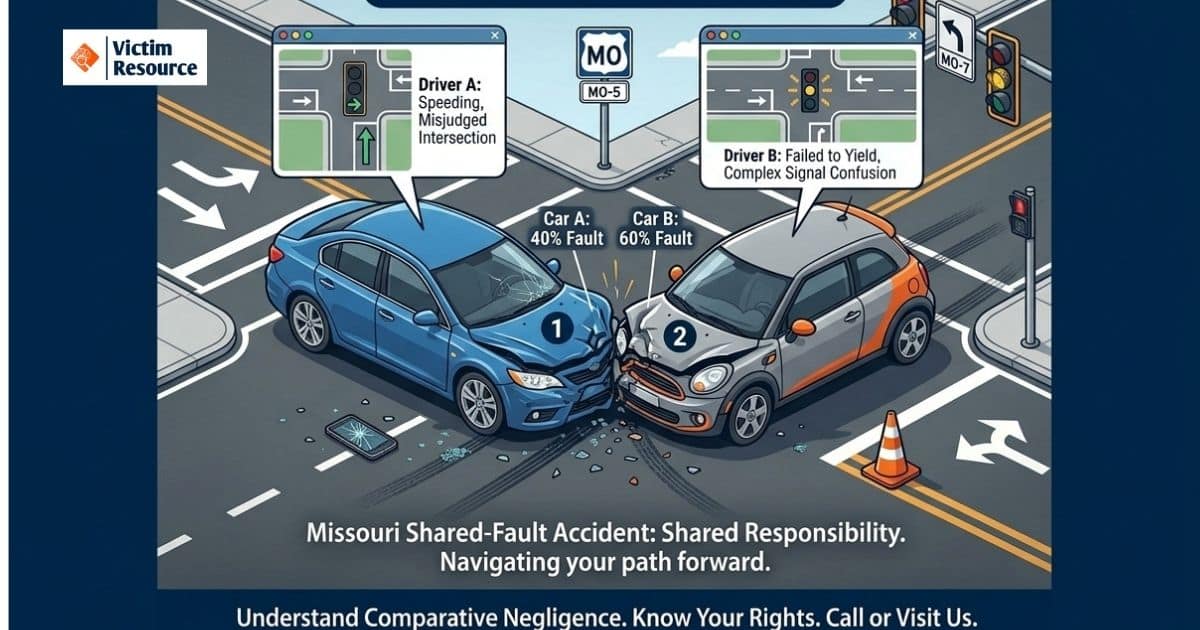

The other driver ran the red light, but you were going a few miles over the speed limit. Or maybe you glanced at your phone right before the crash. Now an insurance adjuster is hinting that the accident was partly your fault, and you’re wondering whether that means your claim is worth nothing.
For many Missouri accident victims, the answer is reassuring. Under Missouri comparative fault rules, being partly to blame does not automatically block you from seeking compensation. It can, however, reduce the amount you receive. This guide breaks down the legal jargon into plain English: what comparative fault means, how fault percentages change settlement math, how blame gets decided, and what steps many people take when fault is disputed.
Victim Resource is an educational platform, not a law firm. Nothing here is legal advice. The goal is to help you understand the landscape so you can ask better questions.
What Is Comparative Fault in Missouri?
In legal terms, “fault” means responsibility for causing an accident. Comparative fault means everyone’s share of responsibility is compared and assigned a percentage. Those percentages add up to 100%.
Missouri follows what’s called pure comparative fault. Until 1983, Missouri followed an older rule called contributory negligence, under which even 1% of blame could bar an injured person from recovering anything. That changed with the Missouri Supreme Court’s decision in Gustafson v. Benda (1983). Missouri’s comparative fault statute, RSMo § 537.765, reflects the same principle: fault chargeable to the injured person reduces the compensatory damages awarded in proportion to that fault, but does not bar recovery.
Pure vs. Modified Comparative Fault vs. Contributory Negligence
States generally fall into three camps:
- Pure comparative fault (Missouri): You can seek compensation even if you’re found mostly at fault. Your recovery is reduced by your percentage of blame.
- Modified comparative fault (Kansas and many other states): You’re barred from recovering once your share of fault reaches a set threshold, commonly 50% or 51%.
- Contributory negligence (a handful of states): Any fault on your part can bar recovery entirely.
Missouri’s approach is among the more forgiving in the country. There’s no cutoff percentage, though if a person is found entirely at fault, there’s no other party to hold responsible.
How Fault Percentages Affect Your Settlement
The basic math is simple. Your total damages are reduced by your percentage of fault.
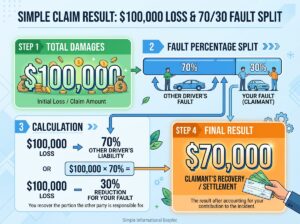
“Damages” generally means the losses tied to the accident. That includes medical bills, lost income, property damage, and non-economic harm such as pain and suffering.
Here’s an illustration using a hypothetical $100,000 in total damages:
| Your Share of Fault | Reduction | Potential Recovery |
| 10% | −$10,000 | $90,000 |
| 25% | −$25,000 | $75,000 |
| 50% | −$50,000 | $50,000 |
| 75% | −$75,000 | $25,000 |
This table is a math illustration only. It doesn’t predict the outcome of any real claim.
Why Small Percentages Matter
Every percentage point carries real dollars. On a $250,000 claim, each 10 points of fault is $25,000. Insurance companies know this. An adjuster who can move you from 0% to 20% fault has cut what the company may owe by a fifth. That’s why fault is often the most contested part of a Missouri injury claim, even when the other driver clearly did something wrong.
How Fault Is Determined After a Missouri Accident
Fault isn’t decided in a single moment. It’s usually worked out in stages:
- The police report. Officers record their observations and sometimes note contributing factors or citations. A report is often influential, but it isn’t the final word on legal fault, and reports can contain mistakes.
- The insurance investigation. Adjusters for each side review photos, statements, damage patterns, and records, then form their own opinions about who was responsible.
- Negotiation. Fault percentages are frequently the center of settlement discussions, with each side arguing for a different split.
- Court, if the claim doesn’t settle. A judge or jury can decide the final percentages.
Evidence That Often Shapes the Fault Picture
- Photos and video of the scene, vehicles, skid marks, and road conditions
- Dashcam, doorbell, or nearby business surveillance footage
- Witness statements
- Vehicle data recorders (“black boxes”) in many newer vehicles
- Cell phone records in distracted-driving disputes
- Medical records showing injury patterns and consistent treatment
Common Situations Where Injury Victims Get Assigned Some Blame
Shared-fault arguments tend to follow familiar patterns:
- Slight speeding. Even a few miles over the limit can be used to argue you had less time to react.
- Sudden braking. In rear-end crashes, the following driver is often blamed, but the front driver’s stop can still be questioned.
- Left turns and intersections. Disputes over who had the right of way are common.
- Lane changes and merges. Each driver may claim the other moved into their path.
- Distracted driving. Phone use by either driver becomes a focus quickly.
- Pedestrian and cyclist crashes. Crossing outside a crosswalk or riding without lights may be cited.
- Treatment gaps. Insurers sometimes argue that missed appointments or ignored medical advice made injuries worse. This is a related but different concept from comparative fault, often called failure to mitigate damages.
Kansas City Accidents: Which State’s Rules Apply?
Kansas City straddles the state line, and that matters. Where a crash happens is a major factor in which state’s laws apply.
- Missouri side: Pure comparative fault applies. Partial blame reduces recovery but doesn’t bar it.
- Kansas side: Kansas uses modified comparative fault, and a person found 50% or more at fault is generally barred from recovering.
Two collisions that look nearly identical could have very different outcomes depending on which side of State Line Road they happen on. Anyone involved in a crash near the border may find it worthwhile to confirm where the collision occurred and how that affects their situation. The police report location is a starting point.
Comparative Fault Beyond Car Crashes
Medical Malpractice
Fault-sharing arguments can arise in medical malpractice claims too. A defense might argue that a patient didn’t follow discharge instructions, withheld relevant medical history, or skipped follow-up care. In many malpractice situations the patient’s own conduct isn’t an issue, but it’s a possible point of dispute. Malpractice claims also involve their own rules and deadlines, separate from those in car crash cases.
Multiple Defendants and Joint Liability
Some accidents involve more than one at-fault party, such as two drivers, a driver and an employer, or a hospital and a physician. Under RSMo § 537.067, a defendant found 51% or more at fault can be held responsible for the full amount of a compensatory judgment. A defendant below 51% generally pays only their proportionate share. This can affect how a settlement is structured when several parties are involved.
Steps Victims Commonly Take When Fault Is Disputed
Every situation is different, but people who find themselves in a shared-fault dispute often take these steps:
- Prioritize medical care. Getting evaluated and following through on treatment creates a record of injuries and shows a consistent effort to recover.
- Document everything early. Photos, witness contact details, and a note of nearby cameras are easiest to gather right away. Some businesses overwrite surveillance footage within days.
- Obtain the police report. Reviewing it for errors, such as the wrong direction of travel or missing witnesses, can be important.
- Stick to facts in statements. Many people avoid guessing about speed, distance, or who was to blame, especially in recorded statements to the other party’s insurer.
- Keep organized records. Bills, receipts, pay stubs, repair estimates, and a simple symptom journal all help show the full picture of losses.
- Be cautious with early offers. A fast settlement offer may not account for future treatment, ongoing symptoms, or a fault percentage that was assigned prematurely.
- Track deadlines. Missouri sets time limits for filing claims (see below).
- Speak with a licensed attorney. Many personal injury attorneys offer initial consultations, which can be a way to learn how the rules apply to a specific situation.
Missouri Deadlines Matter
Missouri’s filing deadlines, called statutes of limitations, are strict. General timeframes include:
- Personal injury (negligence): generally 5 years (RSMo § 516.120)
- Medical malpractice: generally 2 years (RSMo § 516.105), with limited exceptions
- Wrongful death: generally 3 years (RSMo § 537.100)
Exceptions and special notice rules exist, especially for claims involving government entities. Because deadlines can be shortened or extended by circumstances, confirming the timeline for a particular situation is important.
Frequently Asked Questions
Can I get compensation if I was partially at fault in Missouri?
Often, yes. Missouri uses pure comparative fault, so partial responsibility doesn’t automatically bar you from seeking compensation. Any damages are reduced by your assigned percentage of fault. If you’re found 30% at fault on a $100,000 loss, for example, the math points to roughly $70,000.
What if I was more than 50% at fault?
Missouri has no 50% cutoff. Recovery is still reduced by your percentage of fault, so a higher share means a smaller amount. On the Kansas side of Kansas City, a different rule applies, and 50% or more fault generally bars recovery.
Who decides my percentage of fault?
Early on, insurance adjusters form their own opinions. In negotiations, both sides argue for percentages. If a claim goes to court, a judge or jury decides. Police reports, witness accounts, photos, and video all influence the outcome.
Does comparative fault apply to medical malpractice claims?
Comparative fault principles can come up in medical malpractice claims, for example if a defense argues a patient didn’t follow medical instructions. Malpractice claims also have their own procedures and shorter deadlines than most car accident claims.
How long do I have to file an accident claim in Missouri?
It depends on the type of claim. General negligence-based injury claims have a five-year limit, medical malpractice generally two years, and wrongful death generally three. Exceptions exist, so confirming the deadline for a specific situation matters.
Key Takeaways
Being partly to blame doesn’t automatically end your options in Missouri. Under Missouri comparative fault, your settlement is reduced by your share of responsibility, but it isn’t wiped out. Because every percentage point affects the bottom line, fault is often argued hard. Evidence gathered early, careful communication, and awareness of deadlines all play a role. If the crash happened near Kansas City, the state line can change the rules.
If you’re sorting through this after an accident, you don’t have to figure it out alone. Explore the Victim Resource guides linked below, or reach out to a licensed attorney to discuss your options.
Disclaimer: This article is for informational purposes only and does not constitute legal advice. Please consult a licensed attorney regarding your specific situation.
15. Image and Alt Text Suggestions
- Infographic: a simple graphic showing a $100,000 loss, a 70/30 fault split, and a $70,000 result.
Alt text: “Infographic showing how Missouri comparative fault reduces a $100,000 settlement by 30% to $70,000.” - Photo or illustration: two vehicles at a city intersection after a collision, with a driver photographing the scene.
Alt text: “Driver photographing a two-car collision at a Kansas City intersection to document fault evidence.”